
Subscribe to receive top tips, train news and travel inspiration straight to your inbox
London to Salzburg by train
-
Cheapest Price £92.04
-
30 days in advance £128.63
-
7 days in advance £248.58
-
First train05:59
-
Last train20:31
-
Avg changes2
-
Fastest journey10hr 54m
-
Distance1,032 kilometres
-
Trains per day32
-
Avg. journey time15hr 10m
-
Train operators


Travelling from London to Salzburg by train
Want to know how to get from London to Salzburg by train? We have gathered for you all the useful information about this trip!
The fastest trains from London to Salzburg take around 10 hours and 54 minutes, covering a distance of approximately 1,032 kilometres.
On weekdays, the first train leaving London is scheduled to depart at around 05:59. The last departure is usually at around 20:01 . On Saturdays and Sundays, trains leave London at around 06:31, with the last train leaving at around 20:31. There are frequent services on this particular rail route. On average, there are about 32 trains per day travelling between the two cities. They leave approximately every 19 minutes.
Prices for a single ticket between the two cities start from £92.04.
We think any time is a great time to visit Salzburg, as each season has its own unique charm. Nevertheless, please make sure you check the local weather and average seasonal temperatures at destination before deciding on your holiday.
For more tips to help you plan your journey, check out our help articles, or read our guide to Salzburg.
Is there a direct train from London to Salzburg?
The journey between London and Salzburg usually involves changes of train.
We usually find around departures on this route every weekday, counting only those that leave enough time to change trains without waiting around for longer than necessary.
Trains are typically more frequent on weekends, when we found around departures.
How long does it take to travel from London to Salzburg?
The London to Salzburg train travel takes about 10 hours and 54 minutes, no matter when you leave.
What are the London to Salzburg train times and schedule?
If you're travelling on a weekday, you'll find the earliest train to Salzburg leaving London at around 05:59 and the last train leaving at around 20:01 . At weekends, the first train of the day leaves London at around 06:31, with the final departure at 20:31.
Other journeys to Salzburg View all journeys to Salzburg
-
From Munich to Salzburg From £6.41
-
From Vienna to Salzburg From £16.97
-
From Brussels to Salzburg From £31.69
-
From Cologne to Salzburg From £16.60
-
From Zurich to Salzburg From £26.78
-
From Frankfurt am Main to Salzburg From £43.38
-
From Innsbruck Hbf to Salzburg From £16.97
-
From Mannheim to Salzburg From £16.60
-
From Stuttgart to Salzburg From £6.41
-
From Karlsruhe to Salzburg From £21.12
-
From Paris to Salzburg From £43.38
-
From Hammerau to Salzburg From £4.53
-
From Freilassing to Salzburg From £3.39
-
From Ulm Hbf to Salzburg From £18.48
-
From Rosenheim to Salzburg From £6.41
Other journeys from Salzburg
-
From Salzburg to Innsbruck Hbf From £13.58
-
From Salzburg to Mannheim From £33.19
-
From Salzburg to Munich From £6.41
-
From Salzburg to Vienna From £16.97
-
From Salzburg to Brussels From £40.36
-
From Salzburg to Cologne From £36.21
-
From Salzburg to Zurich From £29.80
-
From Salzburg to Frankfurt am Main From £16.22
-
From Salzburg to Budapest From £27.91
-
From Salzburg to From £30.00
-
From Salzburg to Bruck an der Leitha From £36.97
-
From Salzburg to Kufstein From £9.05
Other journeys from London
-
From London to Nice From £41.49
-
From London to Rome From £46.17
-
From London to Florence From £71.67
-
From London to Turin From £43.30
-
From London to Venice From £71.75
-
From London to Verona From £121.09
-
From London to Milan From £43.30
-
From London to Paris From £31.69
-
From London to Brussels From £31.69
-
From London to Berlin From £58.85
-
From London to Frankfurt am Main From £49.42
-
From London to Munich From £49.79
-
From London to Amsterdam From £31.69
-
From London to Rotterdam From £31.69
-
From London to Geneva From £147.87
There are two train routes from London to Salzburg. Travel on the Eurostar and TGV via Paris, or take the Eurostar and ICE via Brussels.
Eurostar & TGV via Paris
It is very easy to travel by train from London to Salzburg. Most passengers favour the route via Paris (which we describe here), but there are alternatives. The route via Brussels sometimes offers better fares. If you opt for the Paris route, your journey starts with a fast run on Eurostar from London to the French capital.
In Paris there is an easy change of stations from the Gare du Nord to the Gare de l’Est – the two stations are so close that you can even walk between them. The second stage of the journey to Salzburg is on a high-speed train to Germany. You may opt for the afternoon direct TGV from Paris to Munich. At other times of the day you may travel from Paris to Munich with just one change along the way. The final leg of the journey, from Munich to Salzburg, is quite short and will generally (though not always) be on one of the Meridian regional trains.
London to Paris

The first part of the journey from London sweeps through Thameside landscapes and rural Kent to reach the Channel Tunnel. Little more than an hour after leaving London you'll already be in northern France, tracking south through Flanders fields towards Paris.
Remember to factor in at least half an hour for Eurostar's airline-style baggage check prior to boarding your train. There is a luggage and body scan and you'll be asked to show your passport. There are no restrictions on taking liquids on board Eurostar trains.
Paris interchange: Paris Nord to Paris Est
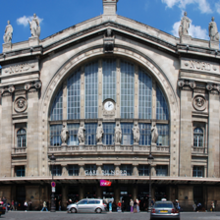
It is an easy ten-minute walk from the Gare du Nord to the Gare de l’Est in Paris. Or if you have lots of luggage consider a (very short) taxi ride for around €10. There’s really no point going by Métro.
If you’re on foot, exit the station from the main entrance and turn left onto Rue de Dunkerque. Walk along the Rue de Dunkerque, crossing Rue du Faubourg Saint-Denis and Rue La Fayette, still continuing on Dunkerque. You’ll come to a T-junction where you turn right into Rue d’Alsace. Follow Rue d’Alsace (you’ll now see the platforms of Gare de l’Est below you to your left) to the flight of pedestrian steps which leads down to the side entrance of Gare de l’Est. Beware of the hustlers who often hang around the steps soliciting donations and offering to carry your luggage.
The route above is the quickest, but for step-free access to Gare de l’Est here’s a slightly longer alternative. Leave the main front entrance of the Gare du Nord and walk straight ahead down Boulevard de Denain (which runs down beside the Café Terminus Nord). Follow Denain to Boulevard de Magenta, turning left onto it. Take the third left onto Rue de 8 Mai 1945 and walk along to the front of the Gare de l’Est.
Paris to Munich
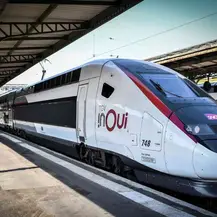
The year-round once-daily direct train from Paris to Munich departs from the Gare de l’Est in Paris and arrives at Munich Hauptbahnhof. A new high-speed line through eastern France opened in 2016, bringing the journey time for the direct Paris to Munich train down to just over five and a half hours. There are several additional Paris to Munich options each day, all requiring a change of train in Stuttgart, Mannheim. Karlsruhe or Frankfurt.
The direct TGV from Paris to Munich tracks east on the high-speed line from Paris towards the German border, sometimes touching 320 kph along the way. After a brief stop in Strasbourg the train crosses the River Rhine and then continues south-east to Stuttgart, where the train reverses. From there it is another two hours with stops in Ulm and Augsburg to Munich Hauptbahnhof, where there is an excellent range of onward connections to destinations in Bavaria, Austria and beyond. The direct train is a French TGV train, with German Deutsche Bahn and French SNCF staff working together on board to ensure the highest levels of customer service.
Munich to Salzburg

Trains for Salzburg all run to the Hauptbahnof in Salzburg. Most of the trains running on this route are Regional Express trains (branded as Meridian services). They make about a dozen stops along the way. There are also a number of Railjet and EuroCity services on the Munich to Salzburg route.
There is a feast of fine scenery on this short ride from Munich to Salzburg. Sit on the right side of the train for the best views of the Alps.
Eurostar & ICE via Brussels
The train journey from London to the Austria city of Salzburg is very easy. There is a great variety of available routes. That via Brussels and Frankfurt offers some rock-bottom fares if you are able to book well in advance. There are alternative options via Paris, continuing from the French capital to Salzburg via either Munich or Zurich. The Paris-Zurich-Salzburg route offers the best scenery, taking in Liechtenstein and the Austrian Tyrol along the way.
The route described here is that via Brussels Midi and Frankfurt-am-Main Hauptbahnhof, which Loco2 commends mainly on account of the fare advantages it sometimes confers.
London to Brussels
Board a Eurostar service from London St Pancras to Brussels. Little more than an hour after leaving London you’ll already be in northern France, speeding through Flanders fields towards Lille Europe, where many but not all Brussels-bound Eurostar trains make an intermediate stop. Some trains make up to three additional stops – at Ebbsfleet, Ashford and Calais.
Eurostar trains from London terminate at Brussels Midi station. Trains run every five minutes from Brussels Midi to Brussels Central (for the city centre). Your Eurostar ticket is valid for this short onward hop within Brussels. At Brussels Midi, there are good onward connections with a choice of Thalys or German ICE trains for direct links to Germany, as well as Belgian (or sometimes Dutch) Intercity trains to cities across the wider BeNeLux region.
Remember to factor in at least half an hour for Eurostar’s airline-style baggage check prior to boarding your train. This is a light-touch security scan, and there are no restrictions on taking liquids on board Eurostar trains.
Brussels to Frankfurt am Main

The direct ICE trains from Brussels to Frankfurt am Main take about three hours for the journey. These trains stop five to eight times along the way. In Brussels these services depart from Brussels Midi and then also stop at Brussels Nord. In Frankfurt trains stop first at the airport station, then continue to the city centre station (Hauptbahnhof) where they terminate.
The route east from Brussels initially traverses the flat lands of Brabant to reach Liège-Guillemins station. East from Liège, the train cuts in tunnels through hilly country to reach the German border just before Aachen. Beyond Aachen, the train speeds east to the Rhineland city of Cologne, arriving at the city’s main station (the Hauptbahnhof). From Cologne, the train continues along a new high-speed line to Frankfurt.
Frankfurt am Main to Munich
High-speed ICE trains leave hourly from both Frankfurt am Main Hauptbahnhof and from the airport station (Frankfurt Flughafen Fernbahnhof) for Munich Hauptbahnhof. Most trains on this route take about 3 hrs 30 mins for this journey of over 400 kilometres.
Running south-east from Frankfurt, the route followed by most trains cuts through the Spessart Hills to reach Würzburg, where vineyards make a lovely backdrop to one of Germany’s most appealing cities. South from Würzburg there are fine views of the landscapes of Franconia and Bavaria en route to Munich where the train runs into the main station (called Hauptbahnhof). Some trains take a completely different route from Frankfurt to Munich, running via Stuttgart and Ulm instead of Würzburg. That route takes in a nice swathe of Swabian countryside.
Munich to Salzburg
Trains for Salzburg all run to the Hauptbahnof in Salzburg. Most of the trains running on this route are Regional Express trains (branded as Meridian services). They make about a dozen stops along the way. There are also a number of Railjet and EuroCity services on the Munich to Salzburg route.
There is a feast of fine scenery on this short ride from Munich to Salzburg. Sit on the right side of the train for the best views of the Alps.