


Game on! Explore the legendary sports stadiums of Germany and France
From track to turf and Marseilles to Munich, here are some of the top stadiums in Germany and France that are sure to impress, no matter which team you’re rooting for.
Summer 2024 is gearing to be an extraordinary year for sports aficionados and travel enthusiasts alike! Germany and France are set to welcome millions of visitors, exceeding pre-COVID levels. As you plan your European excursions, add sports stadiums to your list of must-visit monuments. These venues are not only architecturally impressive but also home to legendary sports teams and cutting-edge sustainable practices.
Olympiastadion: Berlin, Germany

Built in 1936, Olympiastadion is one of Germany’s largest stadiums, accommodating more than 70,000 spectators. Football enthusiasts will remember this stadium as the venue of the infamous final match of the 2006 FIFA World Cup, where Italy beat France in a dramatic penalty shoot-out. Beyond football, the stadium also hosts major concerts of artists including the Rolling Stones, Michael Jackson, Tina Turner, Bruce Springsteen, Beyoncé & Jay Z and Coldplay. It also serves as the venue of the ever-popular music festival Lollapalooza Berlin. If you can’t catch a game or a concert, you can still check out this architectural gem up close and personal by signing up for a guided tour. Conveniently located right smack dab in the heart of the German capital, getting there by train is the best way to travel.
Cologne Stadium: Cologne, Germany
Also known as RheinEnergieStadion, Cologne Stadium was built in 1923 atop the site formerly occupied by the fortifications of Cologne, which were dismantled following the Treaty of Versailles. While best known for its football matches, fans can also catch rugby, hockey and American football games, along with year-round concerts. RheinEnergieStadion also stands out as a renegade in sustainable practices thanks to its use of solar panels and recycled rainwater in stadium maintenance.
BVB Stadion: Dortmund, Germany
Referred to interchangeably as Westfalenstadion and Signal Iduna Park, BVB Stadion holds the title of the largest stadium in Germany, no matter what you call it. With the largest area for standing spectators in all of Europe, the stadium can hold up to 81,000 spectators. You certainly won’t be able to miss the grandstands of the Gelbe Wand, or Yellow Wall, which stand out with its vibrant yellow hues of Borussia Dortmund, the local football club. Never heard of it? We doubt it! Borussia Dortmund is one of the most successful clubs in all of Europe and its fans are known for their passionate crowds. The stadium is an integral part of the local economy, so going to a game is a great way to contribute to the local economy.
Munich Football Arena/Allianz Arena: Munich, Germany

Fans of FC Bayern recognise the iconic silhouette of the Allianz Arena instantly. The stadium's unique form, made out of inflated plastic film, lights up the entire outside of the stadium with a myriad of colours. And such innovation doesn't come cheap - the construction cost a whopping 340 million euros. Unlike some of the other stadiums on this list, Allianz Arena is a more modern addition, opening its doors for the first time in 2006. Not only are there guided tours of the stadium, visitors can explore the museum dedicated to FC Bayern's storied history, which dates all the way back to 1900. As FC Bayern is one of Germany's most decorated clubs of all time, securing tickets to a match can be difficult, even with its staggering capacity of 75,000+ spectators.
Stade de France: Saint-Denis/Paris, France
Constructed for the 1998 FIFA World Cup hosted by France, the Stade de France can hold over 80,000 spectators, making it the largest stadium in all of France. Its nifty retractable roof allows events to carry on come rain or shine. In addition to its football pitch, the stadium also includes track and field facilities. Visitors can also visit the museum and learn about the historic moments that have been celebrated in this stadium, including when France won its first World Cup title in 1998, beating the football powerhouse of Brazil 3-0 right on its home turf of Stade de France. The museum also highlights the meaningful green measures being taken by the stadium to lower its carbon footprint, including its sustainable water, lighting and recycling measures.
Yves-du-Manoir Stadium: Colombes/Paris, France
The Yves-du-Manoir Stadium, or Stade Français Stadium, is used for events like football, cycling and boxing, but is best known for its rugby matches. In fact, the stadium is named for famed French rugby player Yves du Manoir, who tragically lost his life in World War I. Located just to the northeast of Paris’ city centre, visitors coming from outside Paris can easily arrive in the city of light and connect to the stadium via the RER commuter train line.
Stade Vélodrome: Marseilles, France
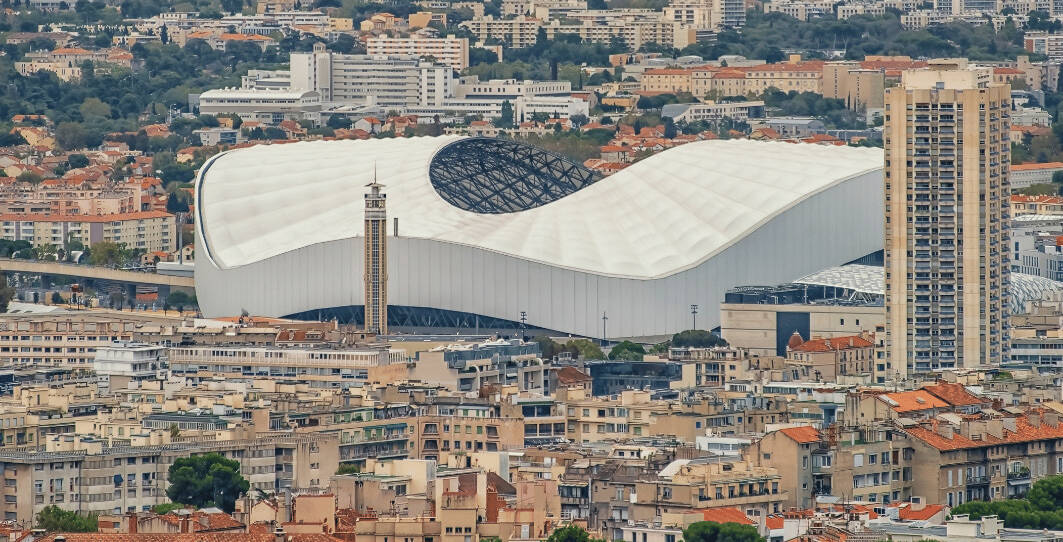
France’s oldest city, Marseille, also boasts the country’s second-largest stadium, with seating for over 67,000 spectators. Best known for being the home turf of the Olympique de Marseille football club, the stadium also hosts rugby matches, concerts and motorsport events. Known for their passionate fans, Olympique de Marseille supporters add to the match excitement with their legendary cheers. The bowl-shape design and iconic roof enhance the roar of the crowd inside the stadium. Located just south of the city centre, sports fans can arrive directly by train and public transportation.
Stade Pierre Mauroy: Lille, France
Named after Pierre Mauroy, the former mayor of Lille and Prime Minister of France, Stade Pierre Mauroy serves as the home of the popular local football club LOSC Lille. Its iconic retractable roof is so immense that it takes an entire half-hour to open and close. However, it is thanks to this roof that football matches, concerts and even basketball games can continue through rain or shine. The stadium was designed to have a low carbon footprint with its energy-efficient lighting and rainwater recycling procedures. While the stadium boasts a helipad to receive VIP guests arriving by helicopter, the stadium’s management encourages attendees to use public transportation to reduce their environmental impact.
Be like your favorite football club and go green!
As you have read, many football clubs and their stadiums have implemented green practices to not be such a burden on the environment. No matter which team you cheer for, be a fan of green travel and get to the next match by train. Not only is train travel the greenest way to get around Europe, it is also the most fun and efficient, as you take off from one city centre and can right off to the next.
Score a goal by visiting these stadiums by train
Getting to the most popular stadiums in Germany and France is a delightful experience by train. Admire the beautiful countryside and connect with other fans onboard. About to miss a match? Don’t worry. Just plug in your device and connect to the Wi-Fi on your train and cheer along. Want a snack for half-time? Head to the onboard café to stretch your legs and grab a quick bite. But make it quick, because before you know it, you'll be arriving at the stadium for the real, in-person action.
Powered by Froala Editor